



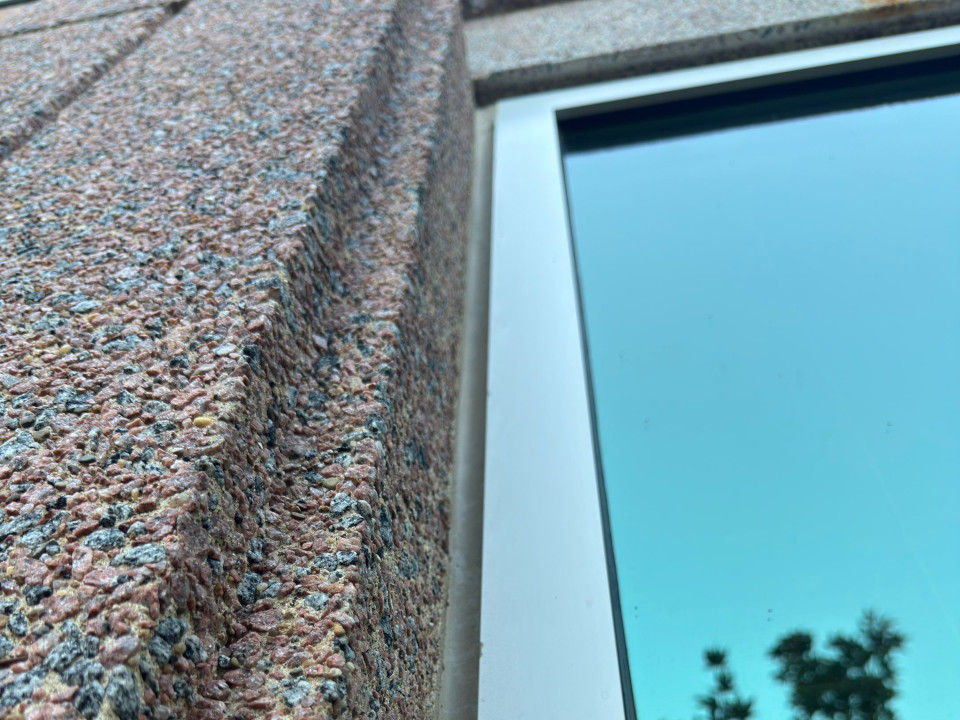
When you’re overseeing thousands of square feet of real estate, it’s easy to forget about waterproofing during property inspection walks. But major envelope issues rarely happen overnight. They start small: a deteriorating expansion joint, a micro-crack in a precast panel, or moisture creeping past a flashing long before it ever registers as an active leak.
When we step onto a job site, we don’t just ask, “Where is the water coming out?” We ask, “How did it get in here in the first place?” Because at N&S, we don’t patch symptoms; we find and fix the source of the issue.
That same diagnostic mindset helps whether we’re on site or you’re conducting your own routine walkthrough. Here are six subtle warning signs to keep on your radar before a small fix becomes a five-figure emergency.
1. Sealants are cracking, shrinking, or pulling away
Joint sealants are your building’s first line of defense. Take a close look at the spots where two different building materials meet: around window perimeters, masonry expansion joints, concrete panels, and mechanical penetrations.
If the sealant looks chalky, cracked, or is visibly pulling away from the substrate, it’s lost its flexibility. That doesn’t mean you have an active leak today, but it does mean there’s a weak point worth addressing before it becomes one. Fixing a failing joint now is a hell of a lot cheaper than tearing out wet insulation six months from now.
2. Concrete or masonry is showing its age
Cracks, spalling (when the face of the concrete starts flaking off), crumbling mortar, or white powdery stains (efflorescence) are all clear signs that water is trapped where it shouldn’t be.
It’s important to remember that visible surface damage is rarely the whole story. Concrete doesn’t just break down on its own—the surface is trying to tell you what’s happening behind it.
3. Protective coatings are peeling or blistering
Deck coatings, elastomeric wall coatings, and traffic membranes all take a beating from weather, UV exposure, and daily foot or vehicle traffic.
If you notice peeling, bubbling, or areas worn down to the bare substrate, the barrier is breached. Once water gets under a coating, it travels laterally, breaking down adhesion further and exposing the material underneath to structural deterioration.
4. You’re seeing corrosion in unexpected places
Rust around structural fasteners, metal connections, handrails, or expansion joint hardware is a huge red flag.
Corrosion doesn’t happen just because air is humid; it happens because moisture is trapped and sitting against the metal. When you spot rust in an unusual spot, ask the key question: Where is that water riding in from? Following that trail usually leads straight to a hidden waterproofing failure.
5. Interior finishes are bubbling or discolored
By the time you see peeling paint, stained ceiling tiles, bubbling drywall, or a musty smell inside an occupied space, the water has already completed a long journey.
Water is sneaky. It can enter on the roof or top floor, travel along a concrete ledger or pipe run, and pop out 30 feet away on a lower level. Don’t just patch the drywall and repaint; trace that path back to the exterior envelope.
6. You keep fixing the same problem
If you find yourself calling a contractor to seal the same spot year after year, it’s time to change tactics. Slapping another bead of caulk or a quick patch over a recurring leak isn’t a solution—it’s a band-aid on a broken bone. If the real entry point is ten feet away, that water will keep finding a way in.
We always tell our clients straightforwardly: you can pay for it now, or you can pay for it twice. The most expensive repair you’ll ever make is the one you have to do over again.
Don’t just find the water. Find the path.
Catching one of these warning signs early doesn’t mean you need to panic or sign off on a massive, budget-busting restoration project tomorrow. It just means it’s time to get an honest assessment of what’s actually going on.
At N&S, we know you’re balancing real-world budget constraints with the need to protect your property’s long-term value. We don’t push one-size-fits-all scopes or force ideal-world scenarios that don’t fit your ledger.
We investigate the entire system, show you what’s happening across all six sides of your building, and give you practical, straightforward options so you can make the right call for your budget and your building’s future.
Because at the end of the day, the goal isn’t just to stop today’s drip. It’s to cure the source so you don’t have to think about it again for the next twenty years.
Have questions about your building’s exterior envelope?
Let’s talk through what your building is telling you—and find the right fix for your budget.
